Case study – Digital Laboratory Excellence: Integrating Automation, Critical Alerts

Hemalatha • Automation in pharmacy, laboratory, and diagnostic services • 23.09.26
Author Affiliations

Clinical and Laboratory Standard Institute (CLSI). AUTO 15 Autoverification of Medical Laboratory Results for Specific Disciplines – Second Edition. CLSI document; Wayne (PA): 2019

Gül BÜ, Özcan O, Doğan S, et al. Designing and validating an autoverification system of biochemical test results in Hatay Mustafa Kemal University, clinical laboratory. Biochem Med (Zagreb). 2022; 32(3):030704. DOI: 10.11613/BM.2022.030704.

Rimac V, Lapic I, Kules K, et al. Implementation of the autovalidation algorithm for clinical chemistry testing in the laboratory information system. Lab Med 2018;49:284–291. DOI: 10.1093/labmed/lmx089

Lenicek Krleza J, Honovic L, Vlasic Tanaskovic J, Podolar S, Rimac V, Jokic A. Post-analytical laboratory work: national recommendations from the Working Group for Post-analytics on behalf of the Croatian Society of Medical Biochemistry and Laboratory Medicine. Biochem Med (Zagreb). 2019;29:020502.

Topcu DI, Gulbahar O. A model to establish autoverification in the clinical laboratory. Clin Biochem. 2021;93:90–8. 10.1016/j.clinbiochem.2021.03.018

Randell EW, Short G, Lee N, Beresford A, Spencer M, Kennell M, et al. Autoverification process improvement by Six Sigma approach: Clinical chemistry & immunoassay. Clin Biochem. 2018;55:42–8. 10.1016/j.clinbiochem.2018.03.002

Jin D, Wang Q, Peng D, Wang J, Li B, Cheng Y, et al. Development and implementation of an LIS-based validation system for autoverification toward zero defects in the automated reporting of laboratory tes

Study Details
Published Sep 2026
Category Automation in pharmacy, laboratory, and diagnostic services
Case Study ID NABH-CS-2026-4877

Initiative

Laboratories faced significant operational challenges due to the manual review and validation of every test result, resulting in increased workload for laboratory staff and inefficient use of skilled resources. The reliance on manual processes also increased the possibility of human errors, leading to inconsistencies in result validation and reporting. Delayed report generation contributed to erratic turnaround times (TAT), affecting the timely delivery of diagnostic information to clinicians and patients. Test mapping across multiple analyzers and systems was complex and often required manual intervention, increasing the risk of data mismatches and workflow interruptions. Inconsistent validation procedures across departments further reduced standardization and quality assurance.

Communication of critical laboratory alerts presented an additional challenge. Identifying critical results and promptly notifying the responsible clinician or healthcare provider was largely a manual and time-consuming process, increasing the risk of delayed clinical intervention. As a result, patients frequently experienced prolonged waiting times for laboratory reports, potentially impacting diagnosis, treatment decisions, and overall quality of care.

These challenges highlighted the need for a robust digital solution capable of automating result validation, enabling reliable bidirectional data exchange, standardizing validation workflows, improving test mapping, and streamlining critical alert notifications. Such a solution was essential to reduce manual effort, minimize errors, improve turnaround time, enhance communication between laboratory and clinical teams, and ultimately deliver faster, safer, and more efficient patient care. AAC4c, COP1i, COP 1J – complies digital NABH

Objectives

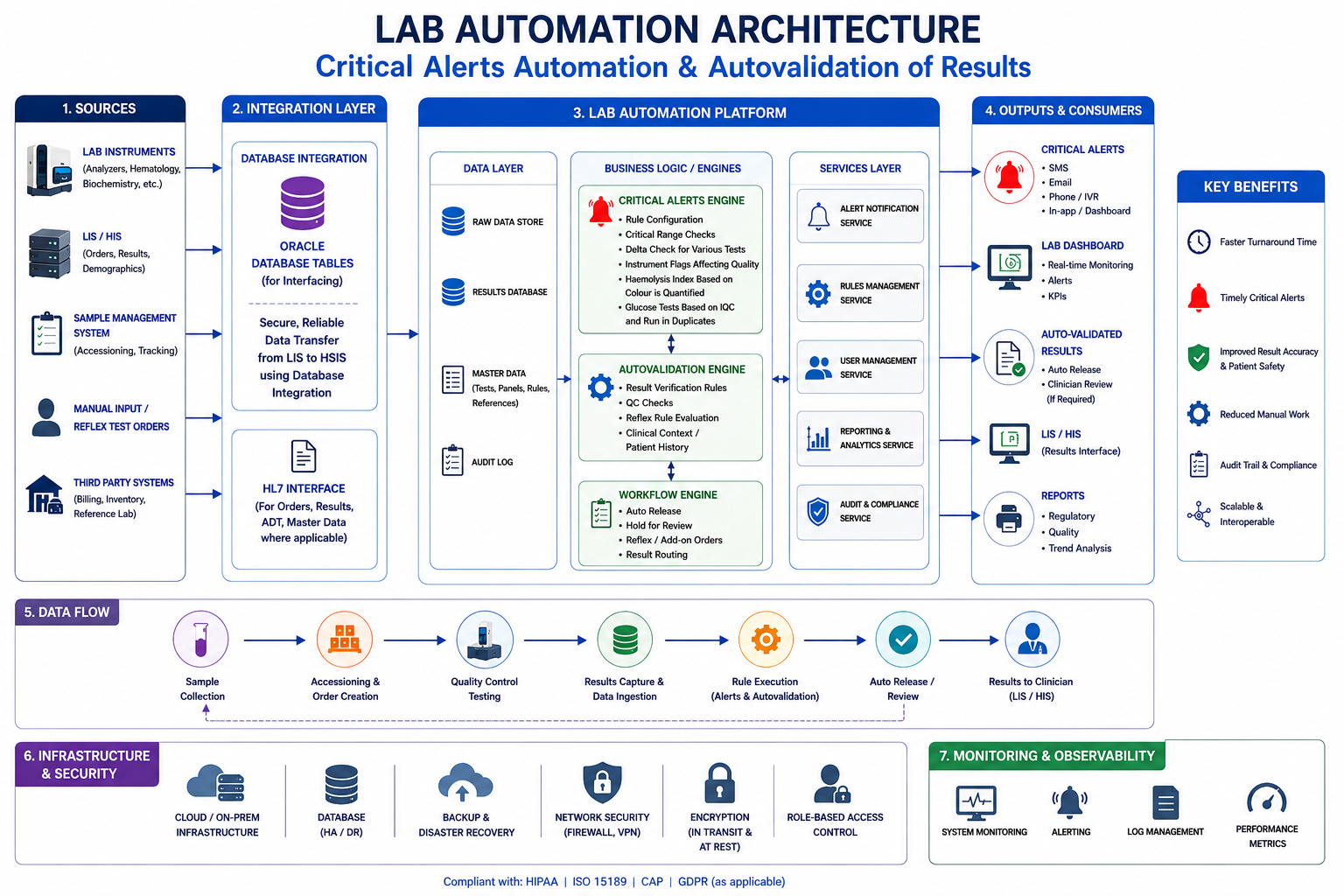
A multidisciplinary team comprising Doctors, Modality Engineers, Laboratory Technologists, and IT professionals designed and implemented an integrated Laboratory Information System (LIS) with a secure bidirectional analyzer interface. Standardized reference ranges, delta check rules, Hemolysis Index (HI) assessment, instrument quality flags, and Internal Quality Control (IQC)-based validation criteria were configured to enable safe auto-validation of laboratory results.

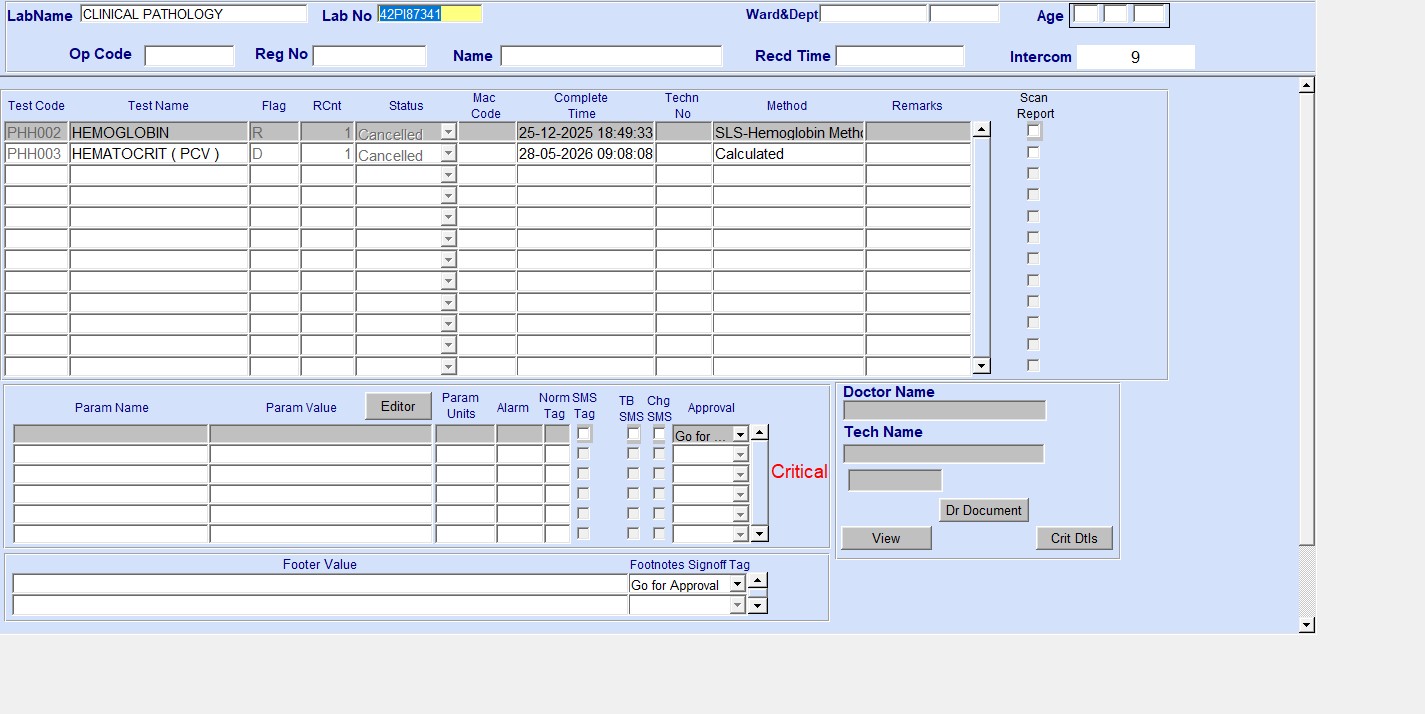
The system was programmed to transmit critical alerts every second from the analyzer through the LIS to the Hospital Information System (HIS), ensuring immediate notification. Incoming results were automatically compared with predefined critical value thresholds, while all abnormal high and low values were automatically flagged for immediate clinician attention. Colour-coded alerts and customized notifications were sent to clinicians, nursing teams, and relevant departments, with mandatory telephonic confirmation for critical values to facilitate prompt clinical intervention and enhance patient safety.

This is also digitized for future reference

Methodology

Digital Implementation Highlight

Time taken for rollout: 1 months
Staff trained: Lab technicians/Doctors
Involvement of IT, Lab technologist & Modulatity specialists
Simple, in house & machine specialist with no recurring cost
Beta testing for Auto validation was done for a few days by performing the tests with and without AV and changes were effected.

Results and Impact

Operational Improvements

Reduced manual review of laboratory results from approximately 7200 reports/day to around 500 reports/day through rule-based auto-verification.

Optimized manpower utilization, enabling laboratory professionals to focus on abnormal and critical results rather than routine validation.

Improved laboratory workflow efficiency through standardized digital validation processes.

Reduced turnaround time (TAT) and expedited report release.

Enhanced patient satisfaction through faster availability of laboratory reports.

Quality and Patient Safety Improvements

Rapid identification and communication of critical laboratory values through automated colour-coded alerts.

Prompt critical alerts helped doctors and caregivers attend to patients immediately without any delays.

Reduced transcription and validation errors by implementing bidirectional analyzer-LIS interfacing.

Improved consistency and standardization of result validation using predefined rules (reference ranges, delta checks, hemolysis index, instrument flags, and IQC).

Increased patient safety by ensuring timely notification to clinicians and digitally recording telephonic communication with complete audit trails.

Improved audit readiness with comprehensive electronic documentation and traceability.

Enabled laboratory experts to devote greater attention to critical and abnormal parameters, improving the quality of clinical review.

Compliance and Sustainability

Successfully aligned the digital solution with the requirements of NABH Digital Health Standards – AAC 6 and AAC 7.

Established a scalable, sustainable, and digitally enabled laboratory workflow supporting

Challenges & Critical Success Factors

Key Enablers and Challenges:

Successful implementation was driven by a strong in-house IT team/Lab team/machine specialists/LIS specialist that ensured seamless interoperability between the Laboratory Information System (LIS) and the Hospital Information System (HSIS). Advanced digital infrastructure, interdisciplinary collaboration among laboratory professionals, clinicians, engineers, and IT staff, along with structured onboarding and hands-on training programs, were key enablers.

Awareness sessions for doctors and nursing staff on critical alerts improved clinical response, while timely communication of these alerts facilitated prompt interventions and, in some cases, proved lifesaving. Automation reduced the burden of repetitive manual result entry, improving efficiency and staff satisfaction.

The major challenges included system downtime and technical glitches, integration with existing hospital systems, ensuring user adoption among laboratory technicians, continuous training of personnel, configuring and optimizing auto-validation criteria, maintaining master configurations and reference ranges, accurately interpreting analyzer flags before report release, and sustaining seamless HSIS integration for uninterrupted workflow.

Key Learnings

An AI-based cutoff system using machine learning can improve laboratory auto-verification by intelligently evaluating serum indices and instrument quality flags. Serum indices, including hemolysis, icterus, and lipemia, are critical for assessing sample quality, as hemolysis can significantly affect potassium results.

AI can combine image-based sample assessment with photometric measurement to optimize analyzer throughput. Samples with severe hemolysis or high serum indices can be automatically rejected, while clear samples proceed without photometric testing. Samples with intermediate indices can undergo selective photometric measurement, ensuring both accuracy and efficiency.

Machine learning can also categorize instrument quality flags according to their impact on result reliability, avoiding unnecessary suspension of auto-verification. Since modern analyzers are modular, issues in one module may not affect others.

This intelligent approach enhances result accuracy, minimizes manual intervention, improves laboratory efficiency, and strengthens patient safety through reliable automated validation.

Supporting Documents