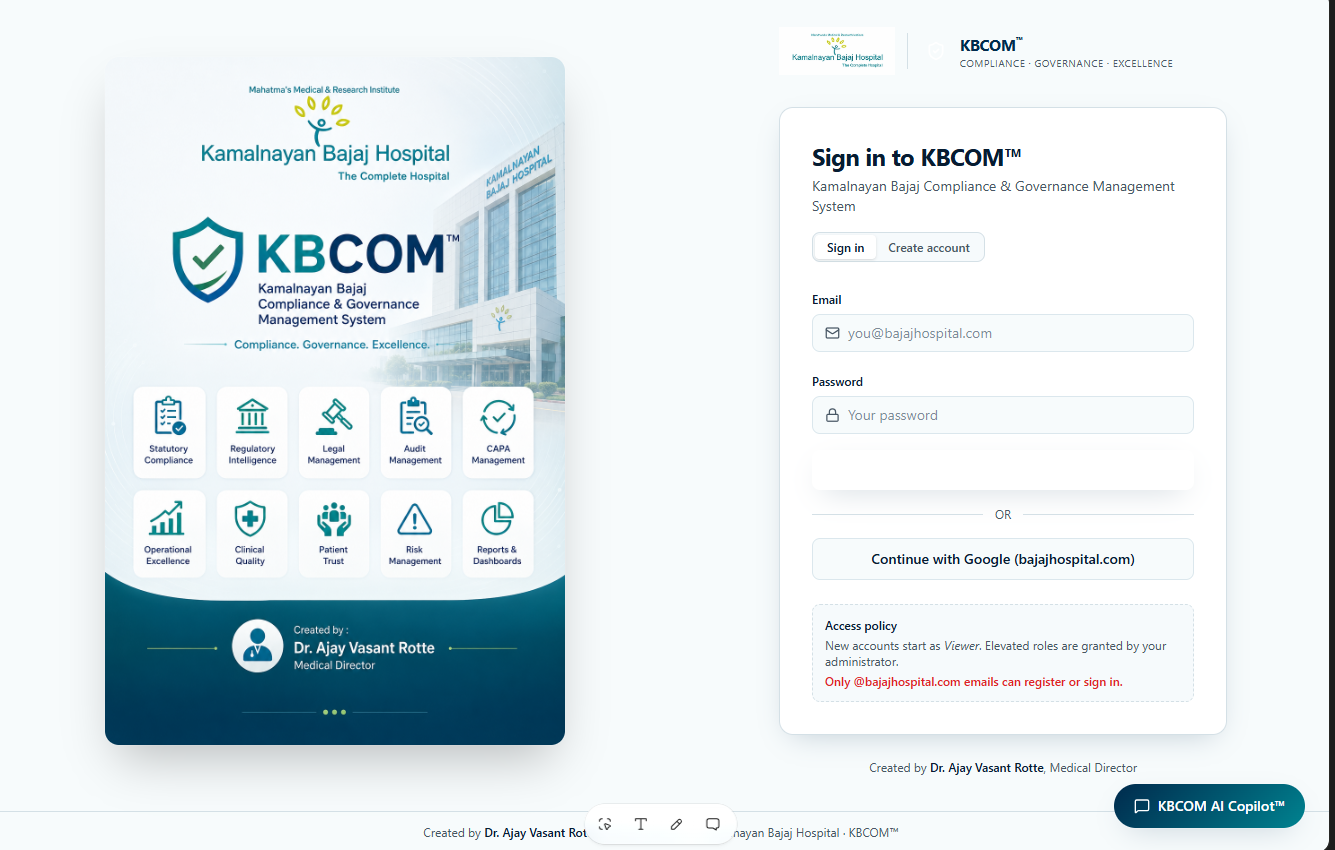
KBCOM Compliance OS™ AI-Powered Integrated Compliance, Legal Governance and Accreditation

AJAY VASANT ROTTE • Digital Excellence • 23.09.26
Author Affiliations

  • NABH 6th Edition Hospital Accreditation Standards
  • NABH Digital Health Standards (DHS)
  • Quality Council of India (QCI) Frameworks
  • Biomedical Waste Management Rules, 2016 (and amendments)
  • Clinical Establishments Act
  • Transplantation of Human Organs and Tissues Act (THOA)
  • Drugs and Cosmetics Act & Rules
  • PCPNDT Act
  • Medical Termination of Pregnancy (MTP) Act
  • Atomic Energy Regulatory Board (AERB) Guidelines
  • National Fire Safety Code and Local Fire Regulations
  • EPF, ESI, Labour Welfare and Occupational Safety Regulations
  • Internal KBCOM Compliance OS™ Documentation, Compliance Register, Audit Records, Governance Reports, and Compliance Health Index An

Study Details
Published Sep 2026
Category Digital Excellence
Case Study ID NABH-CS-2026-4628

Initiative

Healthcare organizations operate in one of the most heavily regulated environments, requiring continuous compliance with numerous statutory, legal, environmental, labour, taxation, clinical, and accreditation-related obligations.

Traditionally, compliance monitoring is fragmented across departments and managed through spreadsheets, emails, paper records, and manual follow-ups. This often leads to limited visibility of compliance status, delayed renewals, duplicated efforts, document retrieval challenges, and increased risk of regulatory non-compliance.

At Kamalnayan Bajaj Hospital, compliance responsibilities span regulatory domains including Biomedical Waste Management, Fire Safety, Radiation Safety, Pharmacy Licensing, Blood Bank Regulations, Clinical Establishment requirements, Labour Laws, GST, EPF, ESI, Transplantation (THOA), PCPNDT, MTP, and NABH accreditation standards.

The absence of a centralized intelligence system made real-time governance and continuous readiness challenging.

The need was identified for a digital solution capable of integrating statutory compliance, legal obligations, accreditation requirements, document management, audit trails, and executive oversight into a single platform.

Stakeholders impacted included hospital leadership, quality teams, department heads, statutory compliance owners, HR, finance, biomedical waste management teams, auditors, and accreditation coordinators.

The challenge directly impacted NABH standards related to governance, patient safety, facility management, risk management, legal compliance, documentation, continuous quality improvement, and organizational accountability.

The objective was to transform compliance management from a reactive administrative activity into a proactive, AI-enabled governance system supporting continuous regulatory readiness and organizational excellence.

Objectives

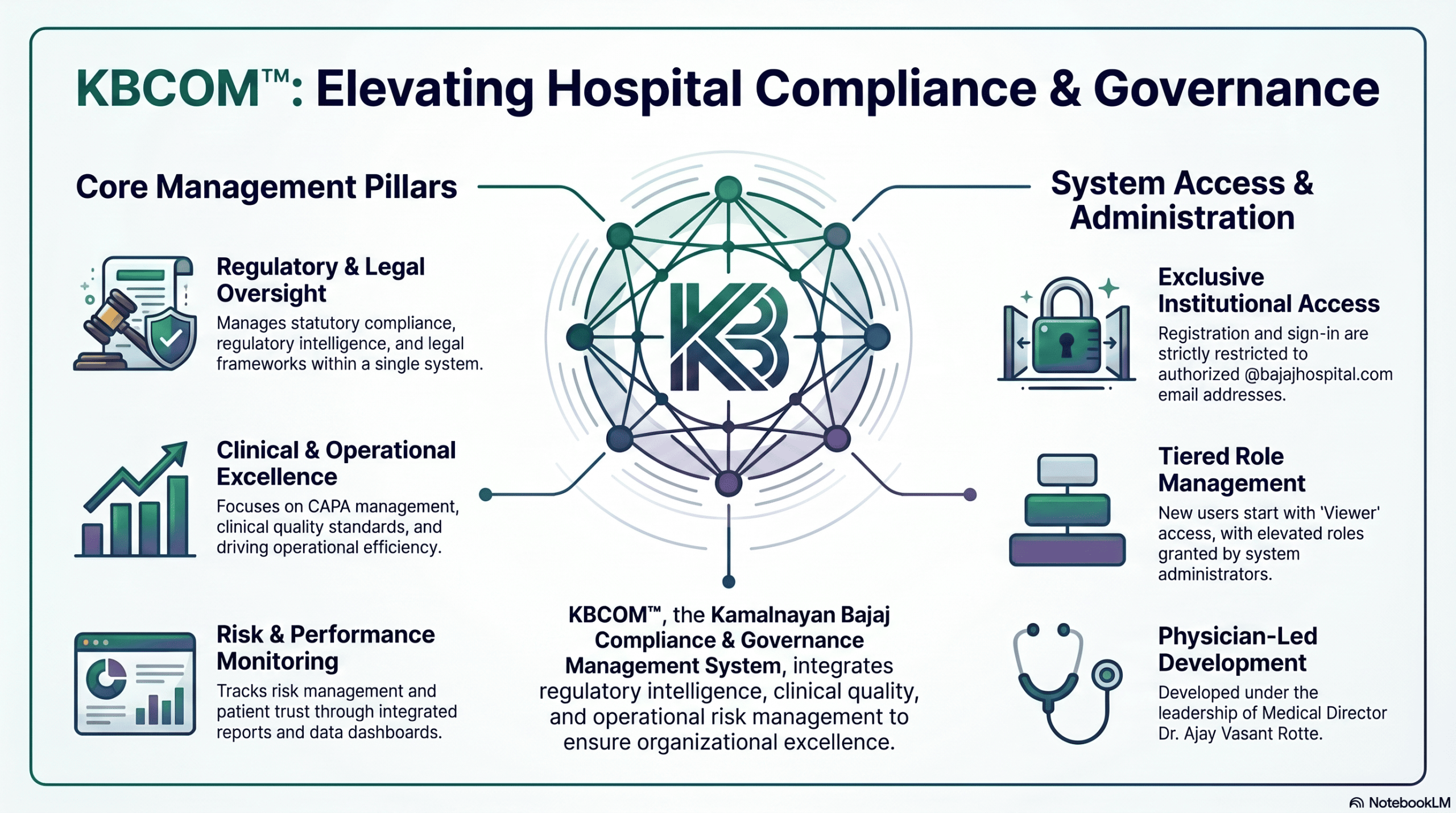
KBCOM Compliance OS™ is an AI-enabled Compliance Intelligence and Governance Platform developed in-house using Lovable AI, workflow automation, secure cloud architecture, and advanced analytics.

The platform manages a comprehensive repository of 177 statutory, legal, accreditation, environmental, labour, taxation, and healthcare-specific compliance requirements.

Each compliance item is digitally linked to ownership, validity dates, renewal workflows, risk classification, regulatory authorities, evidence documents, and NABH standards.

Key features include:

  • Compliance Health Index
  • Smart Renewal & Alert Engine (30/60/90 days)
  • KBCOM AI Copilot™
  • NABH 6th Edition Cross-Mapping
  • Executive Compliance Dashboard
  • Authority-wise Analytics
  • Document Vault with Version Control
  • Role-Based Access Control
  • Immutable Audit Trails
  • Automated Executive Narratives
  • Compliance Risk Monitoring
  • One-click Assessor Evidence Retrieval

The solution serves as a centralized compliance operating system supporting governance, accreditation readiness, risk management, and regulatory compliance.

Methodology

KBCOM Compliance OS™ was conceptualized and developed as a hospital-wide digital governance initiative under the leadership of the Medical Director in collaboration with Quality, Compliance, HR, Finance, Administration, Biomedical Engineering, Infection Control, and Information Technology teams.

The implementation was completed through a phased approach involving compliance mapping, regulatory database creation, document digitization, workflow design, role-based access configuration, AI integration, testing, and user training.

The platform consolidated 177 statutory and accreditation requirements into a unified digital repository linked with compliance workflows and evidence management.

The solution currently supports multiple departments including Quality, HR, Finance, Facility Management Services, Biomedical Waste Management, Fire Safety, Pharmacy, Blood Bank, Clinical Services, Administration, and Hospital Leadership.

Dedicated training sessions were conducted for compliance owners, departmental coordinators, and administrative leaders to ensure effective adoption.

The initiative was championed by Dr. Ajay Vasant Rotte (Medical Director), with active support from Dr. George Noel Fernandes (CEO), Dr. Vidya Bhise (Assistant Manager – Quality), and the multidisciplinary compliance team.

Today, KBCOM Compliance OS™ functions as a real-time Compliance Command Centre, enabling continuous monitoring, proactive governance, audit readiness, digital documentation, NABH compliance mapping, and AI-assisted decision support across the organization.

It has transformed compliance management from a periodic activity into a

Results and Impact

KBCOM Compliance OS™ transformed compliance governance from a fragmented, manually monitored process into a centralized, AI-enabled digital ecosystem.

The platform provides real-time visibility of 177 statutory, legal, accreditation, and regulatory obligations through a unified Compliance Command Centre.

Operationally, the system significantly reduced manual tracking efforts, improved document retrieval times, streamlined renewal management, and enabled proactive compliance monitoring through automated 30/60/90-day alerts.

Leadership teams now have access to real-time compliance intelligence through dashboards, executive summaries, and the Compliance Health Index.

From a quality and safety perspective, the platform strengthened audit readiness, reduced the risk of licence expiries, improved documentation control, enhanced accountability through role-based ownership, and ensured continuous monitoring of regulatory requirements linked to patient safety and operational continuity.

KBCOM Compliance OS™ supports NABH Digital Health Standards by promoting governance, digital documentation, information management, risk management, compliance monitoring, audit trails, role-based access control, and continuous quality improvement.

The NABH 6th Edition cross-mapping module enables rapid evidence retrieval during assessments and strengthens organizational readiness across accreditation chapters.

The platform has established a culture of continuous compliance, transparency, accountability, and data-driven governance while supporting long-term digital transformation objectives.

Challenges & Critical Success Factors

The most significant innovation of KBCOM Compliance OS™ is the integration of Artificial Intelligence, compliance intelligence, accreditation readiness, and governance analytics into a single healthcare-specific platform.

Unlike traditional compliance trackers, the solution functions as a comprehensive Compliance Operating System capable of monitoring, analysing, predicting, and guiding compliance actions.

Key innovations include:

  • AI-powered KBCOM Copilot™ for compliance guidance
  • Compliance Health Index for executive monitoring
  • Smart Renewal Engine with predictive alerts
  • NABH 6th Edition cross-mapping of statutory requirements
  • One-click assessor evidence retrieval
  • AI-generated executive governance narratives
  • Secure Document Vault with version control
  • Immutable audit logs and role-based access control
  • Authority-wise and category-wise compliance analytics

Critical enablers included strong leadership commitment, multidisciplinary collaboration, digitization of compliance records, adoption of AI technologies, and active participation from compliance owners across departments.

Implementation challenges included standardization of diverse compliance requirements, digitization of legacy records, workflow harmonization, and user adoption. These challenges were addressed through phased deployment, stakeholder engagement, training, and continuous platform refinement.

Key Learnings

The project demonstrated that compliance management is most effective when embedded within organizational governance rather than treated as an isolated administrative function.

A key learning was that centralized visibility and accountability significantly improve compliance discipline and audit readiness.

A second learning was that Artificial Intelligence can simplify complex regulatory environments by providing contextual guidance, automated summaries, predictive alerts, and rapid access to evidence, thereby reducing dependence on individual expertise.

Third, integrating statutory compliance with NABH accreditation requirements creates a powerful governance framework that supports patient safety, quality improvement, risk reduction, and operational excellence simultaneously.

The platform is sustainable because it is built on a scalable digital architecture that can continuously incorporate new regulations, accreditation standards, workflows, and AI capabilities.

Future enhancements include predictive compliance risk modelling, automated regulatory updates, benchmarking, and integration with broader hospital governance systems.

The model is easily replicable across healthcare organizations seeking continuous compliance readiness and

Supporting Documents