SECOND OPINION DICOM PORTAL FOR RADIOLOGY

Pranav Mahadeokar • Digital Excellence • 23.09.26
Author Affiliations

National Accreditation Board for Hospitals & Healthcare Providers (NABH) – Digital Health Accreditation Standards.

Digital Imaging and Communications in Medicine (DICOM) Standard – National Electrical Manufacturers Association (NEMA).

Health Level Seven International (HL7) Interoperability Standards.

World Health Organization (WHO). Radiation Protection in Medical Imaging.

American College of Radiology (ACR). Practice Parameters for Teleradiology.

IHE (Integrating the Healthcare Enterprise) Radiology Technical Framework.

Government of India – Ayushman Bharat Digital Mission (ABDM) Digital Health Framework.

Study Details
Published Sep 2026
Category Digital Excellence
Case Study ID NABH-CS-2026-4899

Initiative

A major operational challenge was the inability of patients who underwent imaging at external healthcare facilities to seamlessly share high-resolution DICOM datasets (CT, MRI, Ultrasound, X-ray, and Angiography) for expert subspecialty review. Reliance on physical CDs and hard drives frequently resulted in compatibility issues, delays, incomplete data transfer, and unnecessary repeat imaging. This increased healthcare costs, prolonged diagnosis, delayed treatment decisions, and exposed patients to avoidable radiation.

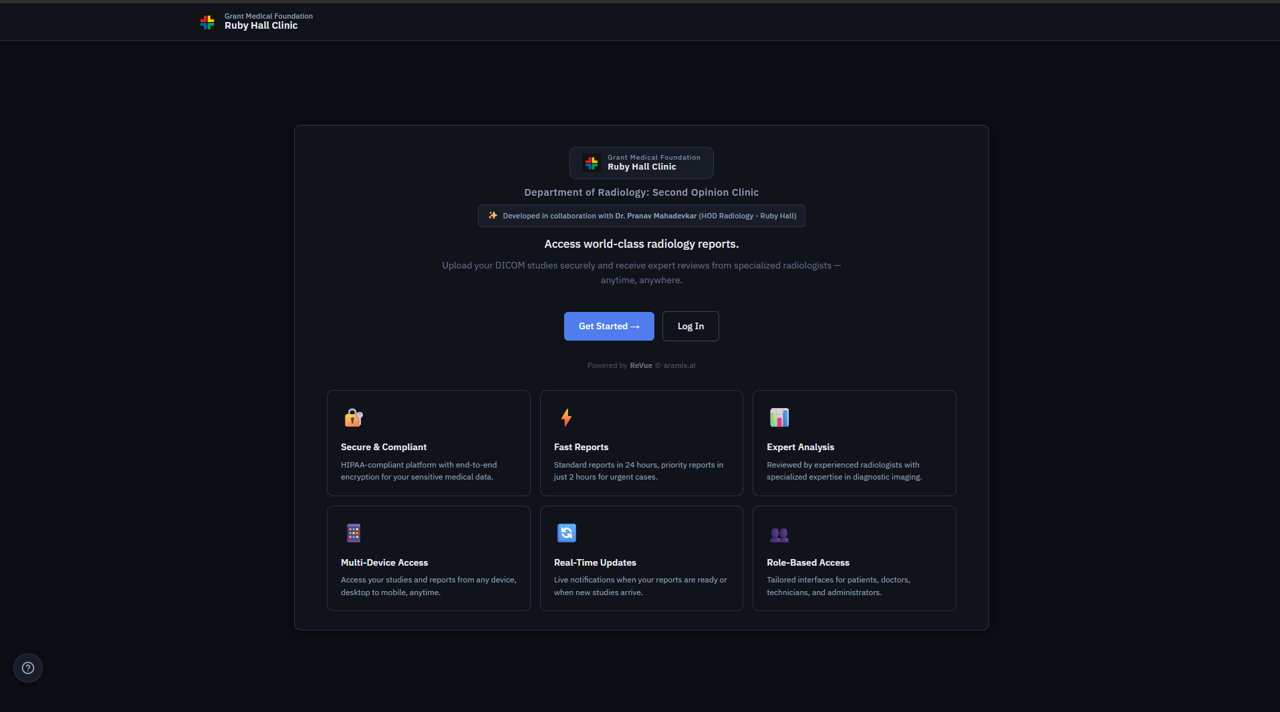
To address this gap, we developed a secure, web-based DICOM portal that enables patients to upload imaging studies remotely from any location. The platform allows subspecialty radiologists to access, interpret, and report examinations without requiring patients to travel or undergo repeat scans. The portal also supports advanced cloud-based post-processing, including specialized applications eg: liver volumetry, enabling sophisticated image analysis even when the originating facility lacks advanced software capabilities.

The solution has significantly benefited multiple stakeholders. Patients receive timely expert opinions while avoiding repeat investigations, additional expenses, and unnecessary radiation exposure. Clinicians gain faster access to definitive reports and advanced imaging analytics, facilitating accurate diagnosis and improved treatment planning. Radiology departments experience streamlined workflows, centralized external case management, and improved reporting efficiency. IT teams benefit from secure encrypted cloud transfer, eliminating dependence on physical media and reducing data security and compatibility challenges.

The initiative aligns strongly with NABH quality indicators by enhancing patient safety through radiation reduction, improving accessibility and continuity of care, strengthening clinical effectiveness through subspecialty reporting, reducing report turnaround time, ensuring secure digital information management, optimizing resource utilization, improving patient

Objectives

Web-based DICOM portal to improve access to care & quality imaging developed by Dr Pranav Mahadeokar (myself) in association with Aramis Imaging LLP.

Methodology

2 months to develop portal

Minimalistic portal – IT team (2 people) trained.

Inbuilt PACS viewer for radiologist reporting

DPDP compliant portal.

Results and Impact

The implementation of our secure cloud-based DICOM Upload Portal has transformed the management of external imaging studies by eliminating dependence on physical CDs and repeat imaging. Patients can securely upload CT, MRI, Ultrasound, X-ray, and Angiography studies from any location, enabling remote subspecialty reporting and advanced image post-processing.

Operational Improvements:

The solution has significantly reduced report turnaround time for external referrals, streamlined case allocation, centralized image management, and eliminated compatibility issues associated with physical media. Automated encrypted data transfer has reduced administrative workload and improved workflow efficiency.

Quality & Safety Improvements:

The portal has reduced unnecessary repeat scans, minimizing avoidable radiation exposure and lowering out-of-pocket healthcare expenses. Secure cloud storage, controlled user access, and complete audit trails strengthen data security and regulatory compliance. Availability of advanced cloud-based post-processing has improved diagnostic precision and pre-operative planning.

The initiative strongly supports NABH Digital Health objectives by enhancing patient safety, continuity of care, accessibility to subspecialty expertise, secure health information management, clinical effectiveness, and patient-centered care. The platform is scalable and enables equitable access to expert radiology services irrespective of geographical location.

We are Asias First Green Radiology Dept certified by ESR (European Society of Radiology) – this is aligned with eco friendly vision.

Challenges & Critical Success Factors

The success of the project was driven by close collaboration between radiologists, IT teams, clinicians, and hospital administration. The portal was designed around standard DICOM protocols with end-to-end encryption, secure cloud architecture, role-based access control, and browser-based viewing, eliminating the need for specialized software at the patient’s end.

A key innovation is the integration of advanced cloud-based post-processing, allowing external imaging datasets to undergo sophisticated analysis—including liver volumetry, vascular reconstructions, and 3D image processing—even when the originating imaging centre lacks these capabilities. This converts a simple image-sharing platform into a comprehensive diagnostic service.

Initial challenges included patient awareness, internet connectivity, and ensuring compatibility across scanners from multiple vendors. These were addressed through simplified upload workflows, automated quality checks, user support, and standardized DICOM validation, resulting in a robust, scalable, and vendor-neutral digital ecosystem.

Key Learnings

The project demonstrated that digital transformation is most successful when it addresses a genuine clinical need while remaining simple for patients and clinicians to use. Standardization through DICOM compatibility and secure cloud architecture ensures long-term sustainability and seamless scalability across multiple hospitals.

Our key learnings include:

• Patient-centric digital solutions significantly improve access to specialist care while reducing unnecessary investigations.

• Vendor-neutral platforms are essential for interoperability across diverse healthcare settings.

• Advanced cloud-based image processing can democratize access to high-end radiology expertise without requiring expensive local infrastructure.

• The platform is sustainable, requires minimal additional hardware, and can be expanded to support tele-radiology networks, multidisciplinary tumour boards, AI-assisted image analysis, and collaborative reporting, making it a scalable model for digital healthcare delivery.

Supporting Documents